Over 3,000 people across the Pacific are seeing human rights in a new light thanks to the 5th Pacific Human Rights Film Festival’s powerful regional screenings. This year’s festival, on the themes of ‘Loss, Damage, Resilience, Restoration’, helped raise awareness of human rights issues with the aim to contribute to a more just and compassionate society.
Despite progress by Pacific Island countries to uphold human rights commitments, there are still socio-economic, political and cultural inequalities and rights violations due to inadequate capacity, lack of human rights institutions, power imbalances, exclusion, and discriminatory norms, attitudes and practices. This annual festival brings human rights to the big screen, providing space for Pacific people to engage with these stories and build their awareness about human rights issues in our region and beyond.
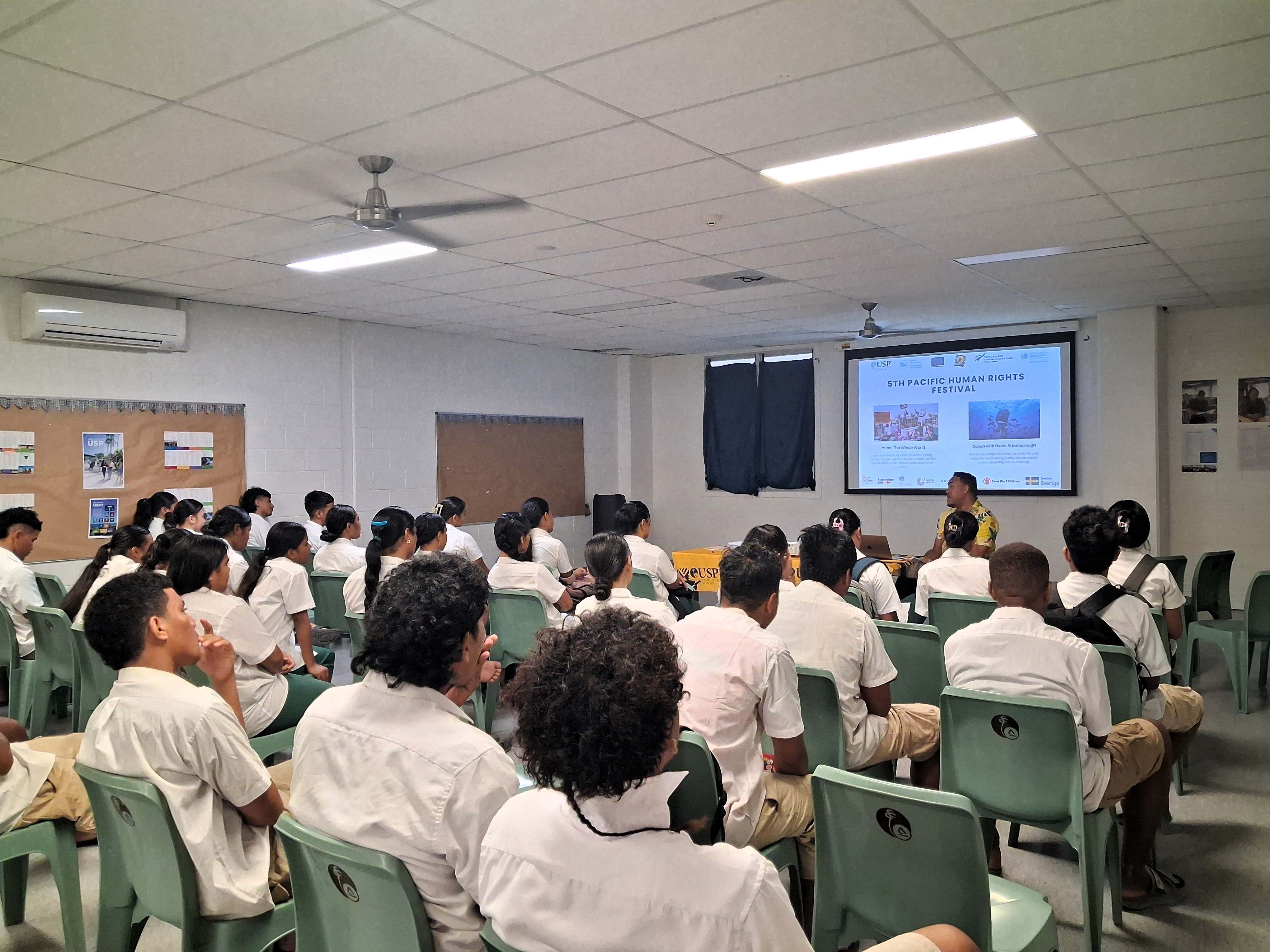
In Fiji, the Festival started with the audio-visual Oceanic Refractions art installation (25 August to 19 September), then brought the magic of films to students from 10 secondary school schools across Suva, as well as University of the South Pacific (USP), Fiji National University and University of Fiji students (22 to 26 September). The school screenings were facilitated by the Ministry of Education.
Finally, it culminated in popular public screenings at Damodar City Cinema and USP in Suva, from 27 September to 18 October, and 8 October in Lautoka. These Fiji public screenings alone were attended by nearly 2,000 members of the public. The films included two Academy Award winners, Pacific and international documentaries and narrative films, and a special family-focused event that featured Fijian child actors at the post-screening Talanoa.
The Festival also brought these exclusive films to venues around the region – Cook Islands, Saipan (Northern Mariana Islands), Nauru, New Caledonia, Samoa, Solomon Islands and Tonga – ensuring that other Pacific Islanders could be a part of the Festival and engage with the human rights issues in the films.
Films screened touched on themes of the climate threat to the Pacific, intergenerational trauma and grief, the exclusion of traditional Pacific identities and communities, and war. The post-screening discussions provided a safe space for audiences to discuss these important issues with experts and human rights advocates and learn more about the films by meeting film crews.
Miles Young, Director of the Human Rights and Social Development division at SPC: “We are delighted to see record audience numbers at the Pacific Human Rights Film Festival this year – it’s encouraging to witness so many people engage with these films and their human rights themes. The discussions that followed the films were respectful, thought-provoking and insightful, and reflected the diversity of views that audiences hold on the various human rights issues raised. The festival is an effective way of promoting human rights in the Pacific and SPC is committed to this event well into the future”.
Dr Manumatavai Tupou-Roosen – Acting Deputy Vice-Chancellor & Vice- President (Regional Campuses and Global Engagement) at USP said: “USP is proud to have partnered with the Pacific Human Rights Film Festival since its inception 5 years ago. Through it we have expanded learning environments beyond the traditional lecture hall and into incredible cinematic worlds on campuses across the Pacific.”
Heike Alefsen, Regional Representative of the Office of the UN High Commissioner for Human Rights (OHCHR) for the Pacific “As we mark the UN80 anniversary, the 5th edition of the Pacific human rights film festival reminds us that the fight for human rights is far from over. Selected films have shown us how courage, creativity, and conviction help shaping a more just and equitable future. At a time of growing global pushback, Pacific voices are a powerful call to protect dignity, human rights
and freedom for all.”
Charlotte Darlow, New Zealand High Commissioner to Fiji said: “New Zealand’s partnership with the PHRFF reflects our commitment to continue advancing the cause of human rights and gender equality for all. May the stories shared through this festival continue to inspire and bring positive change in our societies”.
H.E. Barbara Plinkert, Ambassador of the European Union to the Pacific, said: ‘‘The European Union is honoured and proud to have supported the fifth Pacific Human Rights Film Festival and contributed with the EU film “Flow”, which conveys the need for us to work together in the face of challenges we all share. The festival has become a powerful platform through which stories of strength, resilience, and survival are shared through film, amplifying the voices and solutions that matter most – and we remain committed to standing with the Pacific in the promotion and protection of human rights.’’
Jone Robertson, Chief Executive Officer, Film Fiji, said: “Collaborating with festivals like the Pacific Human Rights Film Festival allows Film Fiji to elevate local filmmakers, as seen through our work with the Suva International Short Film Festival, by pairing locally produced content with globally acclaimed films that audiences in Fiji might not otherwise experience.”
This year’s festival is organised by the Pacific Community (SPC), the University of the South Pacific (USP), the Delegation of the European Union to the Pacific, Film Fiji, the New Zealand Ministry of Foreign Affairs and Trade (MFAT), UN Human Rights Office (UNOHCHR), with support from Ambassade de France a Fidji, Kiribati, Nauru, Tonga et Tuvalu (the French Embassy in Fiji, Kiribati, Nauru, Tonga and Tuvalu), the Australian Government Department of Foreign Affairs and Trade (DFAT), British High Commission in Fiji, The Goethe-Institut New Zealand, Oceania Centre for Arts, Culture and Pacific Studies, Save the Children, and the Swedish International Development Cooperation Agency (SIDA).