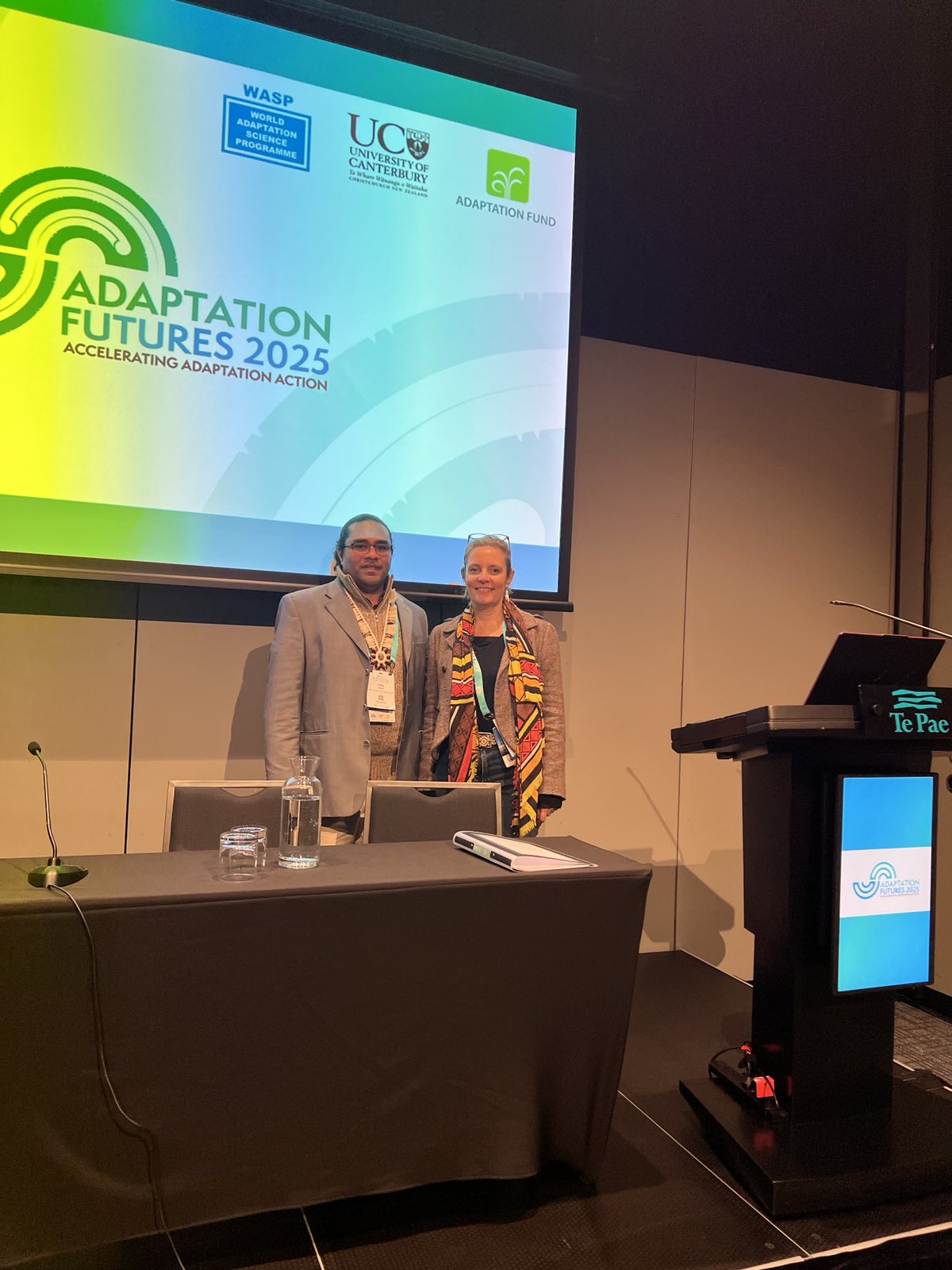
The University of the South Pacific’s Centre of Sustainable Futures (CSF) Researcher, Filipe Veisa was among the notable experts who participated at the recent 2025 Adaptation Futures Conference in Christchurch, New Zealand.
The Adaptation Futures Conference which is the premier international conference, brought together researchers, policymakers, practitioners, industry representatives and communicators, to share their work in adaptation and build networks among professionals like Veisa.
Veisa served as one of the panellists, speaking on the critical topic: “Shifting Food Systems: Climate Crisis and Food Security in Pacific Island Countries and Territories (PICT).”
Veisa said his attendance underscored the growing recognition of adaptation as a primary pathway for survival and justice.
“My attendance at the Conference is in many ways inspiring and hopeful,” Veisa said.
“Indigenous and place-based voices are claiming space that adaptation is increasingly being seen, not just as mitigations “less glamorous sibling” but as central to climate justice, resilience and survival.”

He added that these crisis’ is intensely exacerbated by climate impact.
“The transition of our food system in the Pacific from a nutritious traditional diet to a more ultra-processed foods are increasing. This is further worsened by climate change due to loss of land, rise in sea levels thus resulting in our slow recovery for our communities,” he added.
“The main question that we asked, how could we understand and address climate change impacts on food security and reduce non-communicable diseases in PICTs?”
“There are geopolitical, colonial and historical realities that frame and build the current mindset, coupled by the challenges of addressing climate change and food and nutrition insecurities in PICs.”
He highlighted that ongoing work is underway to revive traditional food preservation knowledge, citing the case study from Nabuna village on Koro Island in Fiji.
“I also emphasised on the work currently on going on the Global community food for planetary health project (GCFaH), looking at the potential of improving household diet, nutrition and food security in reducing the burden of nutrition related diseases through increased community-based food production based on agroecological principles in small island countries,” he said.
“There is still alot to be done to address this issue, however, it will need global, national, local efforts to drive this to ensure that we are able to sustain our livelihood, our homes, land and our environment for future generation.”
He stressed that to address climate change their must be an integrated understanding of the NCD status and the cultural role of food.
“So how does climate change is impact our food system, whether its an urban, rural or atoll, depending on where you are, the source of food is also a source of money,” he added.
“It is also a source of money at household level, the local production decreases, it decreases income, and thus increases prices of healthy food choices, so it pushes people to more ultra-processed food, because we can’t control the cost of food.”
“Our Pacific food system is strongly connected to the Global food system and thus making it highly vulnerable, not just to local impacts of climate change but also global impacts, so we have no food sovereignty, zero food security and zero food self-sufficiency.”
His participation highlighted the critical and interconnected challenges faced by PICTs regarding climate change, food security, and public health.
This conference is the flagship event of the World Adaptation Science Programme, one of the four components of the World Climate Programme. The trip was made possible through the project POCCA (Pacific Ocean Climate Crisis Assessment Project), funded by MFAT.