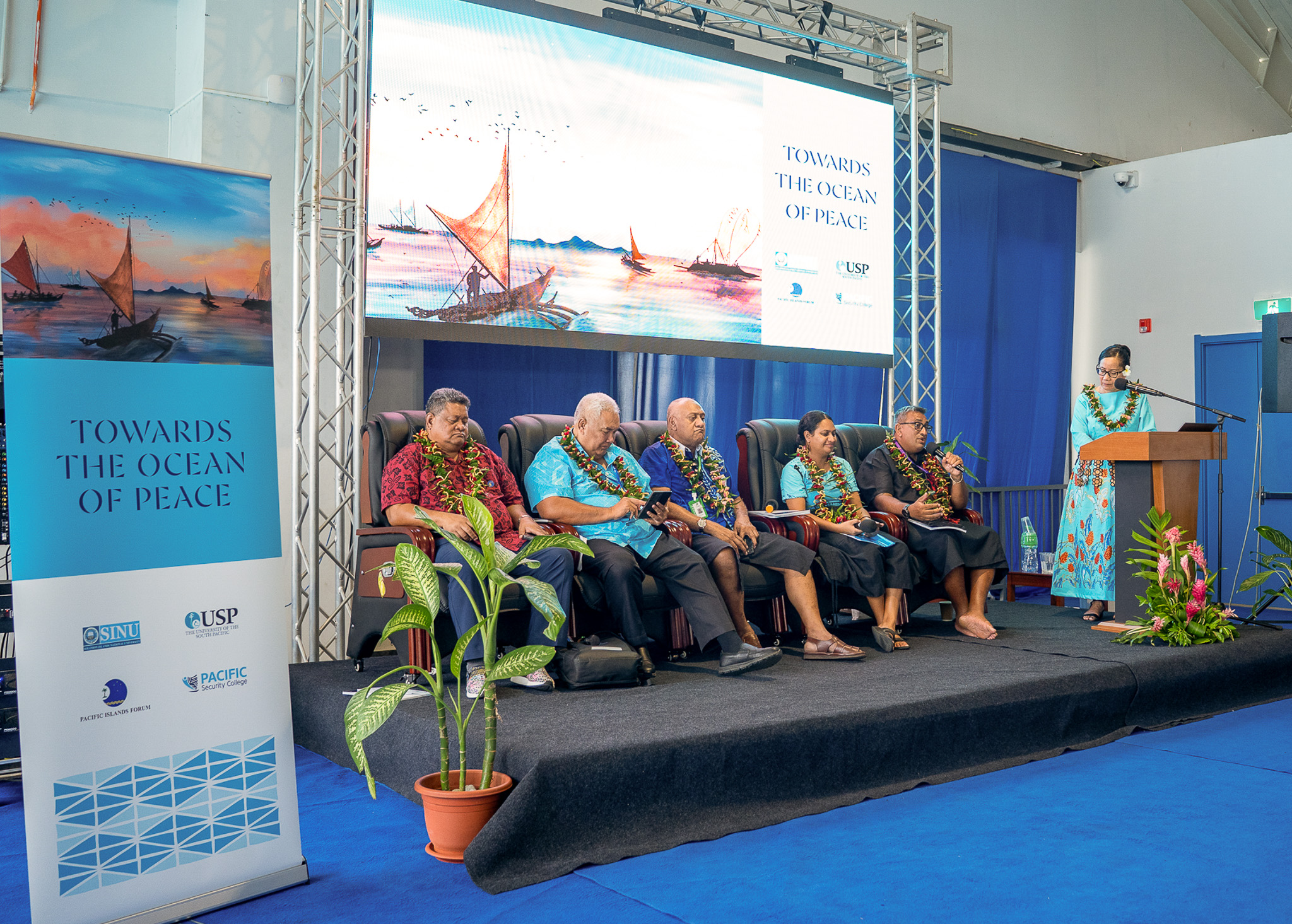
At the Building an ‘Ocean of Peace’ through Strengthened Regional Integration – a side event at the 54th Pacific Islands Forum Leaders’ Meeting in Honiara, Solomon Islands last week – speakers emphasised the importance of regional and international collaboration to bring the Ocean of Peace vision to life.
Panellists included Palau’s Minister of State, the Honourable Gustav Aitaro; Cook Islands’ Minister of Foreign Affairs and Immigration, the Honourable Tingika Elikana; Pacific Ocean Commissioner Dr Filimon Manoni; General Secretary of the Solomon Islands National Youth Congress Ms Josie-Anne Ashley; and General Secretary of the Pacific Conference of Churches, Reverend James Bhagwan.
The event was moderated by The University of the South Pacific (USP), Acting Deputy Vice-Chancellor & Vice-President (Regional Campuses and Global Engagement), Dr Manumatavai Tupou-Roosen.
The speakers highlighted how the Blue Ocean of Peace Declaration could unite the region in tackling shared challenges such as climate change, ocean degradation and geopolitical tensions, and called for stronger partnerships, greater involvement from young people, and Pacific-led solutions.
Panel moderator Dr Manumatavai Tupou-Roosen said the Ocean of Peace Declaration “affirms the Pacific’s identity as a region of peace”.
“[A region] where our ocean binds us together as one family, and where our unity is our greatest strength in responding to the challenges of the world,” she said.
Palau’s Minister of State, the Honourable Gustav Aitaro, acknowledged the significance of the Declaration, which was adopted by Forum Leaders on Wednesday.
“The ocean connects all of us, so it’s our responsibility to ensure that we provide peace and security to our communities,” Minister Aitaro said.
“It’s very important at this time that we come together… We’re all Pacific Island brothers and sisters, and we’ve proven it.”
Minister Aitaro also stressed the importance of cooperation with international partners, noting “we cannot do this alone”, and suggested they should sign the Declaration next year.
“External partners should also understand, they should also learn that they are also responsible to be with us on this path towards peace and keeping peace in the Pacific.
“Anything that happens outside of the Pacific, we suffer the most. We emit the least, we suffer the most. And if there’s a conflict somewhere, we suffer by inflation. So, everything that happens outside of us is affecting us, maybe tenfold.
“In order to have our dialogue partners understand, we have to show them the leaders have spoken. They have spoken on behalf of their people, their community, their youth, their faith-based organisations. That’s why they signed on to the Declaration.
“The Declaration should be disseminated to all our dialogue partners and development partners to understand that the region is concerned, and now they have spoken. And they should follow our rules, and those rules are not only ours, they will be their rules as well.
“We’re not restricting, we’re open – that’s the Pacific Way.”
Cook Islands’ Minister of Foreign Affairs and Immigration, the Honourable Tingika Elikana, said the Pacific faces numerous challenges, including climate change and geopolitical tensions. He highlighted that collaboration and proactive support from global partners is key to addressing these issues in the region.
Pacific Ocean Commissioner, Dr Filimon Manoni, observed that, in 2025, the Pacific has “mobilised in numbers” to deliver a strong and unwavering message to the global community about what must be done to secure peace in the region, and about the kind of legacy leaders must leave for future generations.
“We take leadership, we contribute to the global discourse. We influence decisions that come out of global forums, because if you stand aside, your voice is not heard, your contributions are not heard, and then a decision passes you by.
“As leaders, that would not be the ideal situation. The stakes are too high for us not to be taking this kind of approach in our discussions around the ocean.”
General Secretary for the Solomon Islands National Youth Congress, Josie-Anne Ashley, called for leaders to look inwards at issues affecting the region, in addition to focusing on the bigger picture globally.
“How can we make sure that our children go to school without interruption? Or how can we create a healthy environment which is free from contamination, and our families have enough food to eat?” she said.
Reverend James Bhagwan, General Secretary, Pacific Conference of Churches, urged leaders to ground the Ocean of Peace in the everyday realities of Pacific people.
“The test for an inclusive Ocean of Peace is practical. It’s just a simple question: will this declaration ensure that life and dignity is improved for our market women, our young people, persons with disabilities, and our maritime families, and if not, then it’s not peace, it’s publicity,” he said.
The building an ‘Ocean of Peace’ through strengthened regional integration event was presented by the Pacific Islands Forum Secretariat, The University of the South Pacific, Pacific Security College and the Solomon Islands National University.