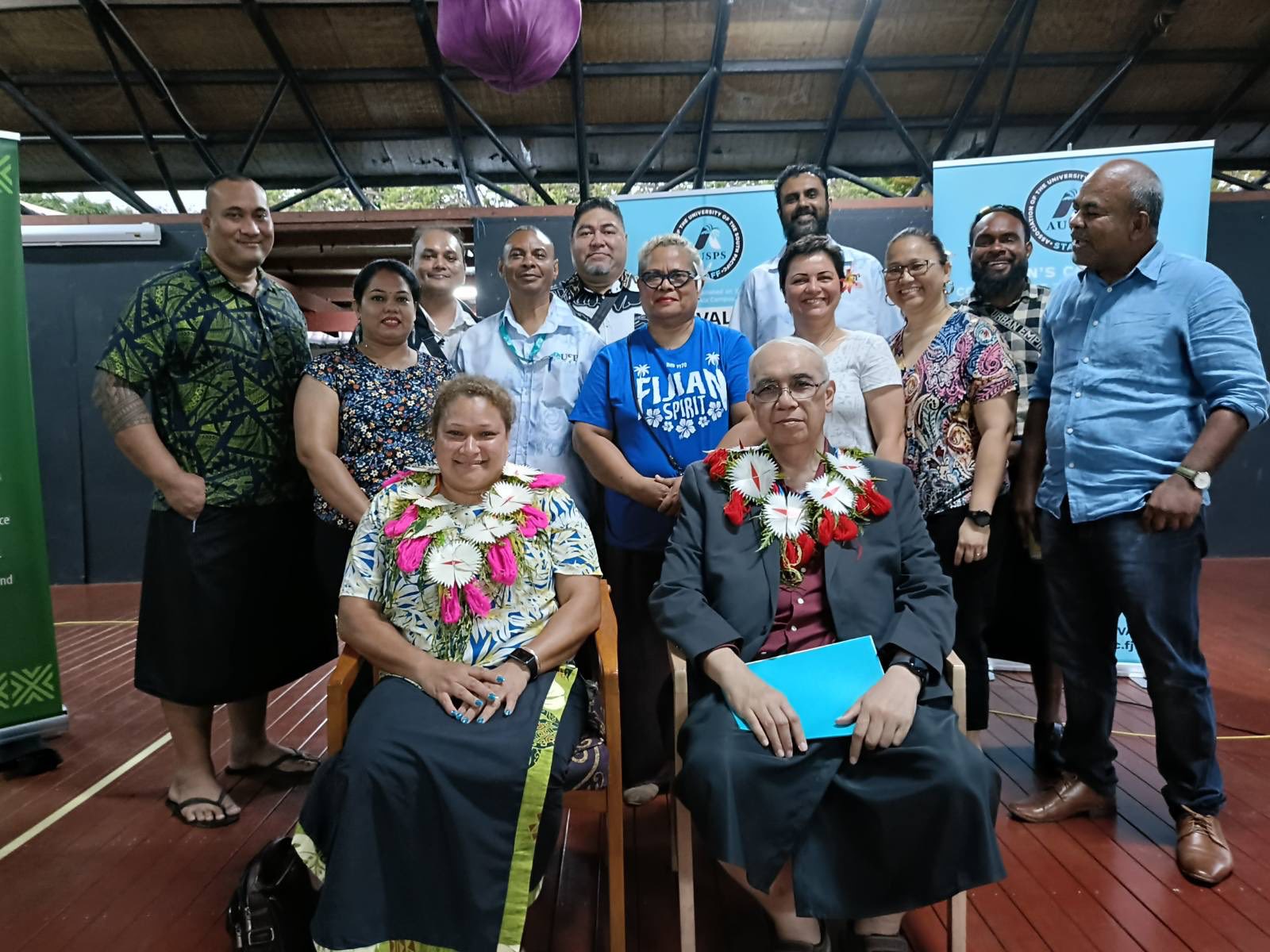
The following speech was delivered by USP Pro-Chancellor and Chair of Council Siosiua Utoikamanu at the Association of the University of the South Pacific Staff (AUSPS) and USP Staff Union (USPSU) Thanksgiving Cocktail function on 3 October. It is being published for its strong relevance to the USP community and its wider importance to the Pacific region.
There is a Pacific proverb that says: “The sea is our mirror; it shows us not only the sky above but the depths beneath.”
I have been reflecting a great deal lately. Reflection is not passive. It is active, searching, sometimes uncomfortable, but always necessary. The act of looking into a mirror is not just about what we see, but what we are prepared to face.
Our university is in a period of reset. At the Solomon Islands graduation only a couple of weeks ago, I spoke about USP as a mirror of our communities. I said that if USP were a mirror, our people should see themselves in us: their voices, their priorities, and their aspirations. That message resonated deeply, and it is the same challenge that faces us now in this transitionary phase.
This is not a time for hesitation. It is a time for courage, clarity, and self-examination. The Interim Management Group was formed to hold the University in trust and to ensure that while we search for a new Vice-Chancellor, USP is not merely waiting but actively resetting. And I am proud to say that in just four weeks, the IMG has already begun to show what can be achieved when leadership is shared and exercised with humility and urgency.
Among the IMG’s first actions has been to authorise the long-awaited staff survey. For too long, we delayed taking the temperature of our own University. This survey is our mirror. It will help us to look at ourselves honestly and to understand the sentiments of our staff. We expect the feedback to be frank. Some of it may be confronting. But that is the point of a mirror. It does not flatter, it reveals. And while we await the results, our own instincts already tell us there are matters we must address now rather than later.
We have also begun to act on what I call “deferred maintenance”. This is not only about buildings and physical assets, but about people. Tonight, I want to acknowledge the return of Dr Tamara Osborne. Her presence among us again is a reminder of the importance of valuing and learning from the past as we build a stronger future together.
Another area of focus is salaries and conditions. We are now negotiating salary reviews and preparing collective agreements across our region. The IMG’s vision is that these agreements should not simply be legal contracts. They should be covenants, commitments built on trust and respect, not on grace, favours, or patronage. If we achieve this, it will be the first time in USP’s history that we will have comprehensive collective agreements covering most, if not all, of our region. That will mark a significant milestone in how we value and relate to our staff. We want USP to be known as the employer of choice across the Pacific, trusted by the very communities we serve.
Recently, I also had the opportunity to make it clear that research of Pacific significance and relevance cannot be treated as a side concern of the University. It must sit at the very heart of USP’s academic mission. Our research awards, for example, should celebrate work that speaks directly to regional priorities and strengthens our identity as the University serving the Pacific. This is another example of how the work of resetting our compass in both our values and our focus needs to begin immediately.
At the same time, we must look honestly at our own staff policies. When we examine the profiles of our academic staff across the levels of seniority, they do not reflect who we are as a regional university. Why are there still no women professors? Why do the senior ranks not mirror the diversity of our region? We must also adjust our settings to celebrate teaching. USP remains fundamentally a teaching university, yet sixty years on we still do not honour and reward excellent teaching as we should. The staff demographic statistics at USP should be a mirror of our communities. At present, they are not. That too must change if we are serious about resetting who we are and what we stand for.
The IMG has also convened important discussions with members of Council, the Finance Committee, and the University Grants Committee in the lead-up to the next triennium. These conversations are not easy, but they are essential. They allow us to share our priorities and to listen to critical feedback as we begin to shape budgets and plans for the remaining years of this triennium, with an eye on the next. This is what responsible custodianship looks like.
At the same time, the search for a new Vice-Chancellor has begun. Council has appointed its members to the Joint Committee of Council and Senate, and Senate will shortly be asked to appoint its two representatives. In the past, it was insisted that only professors should serve. I have argued differently. USP is a regional university, and our representation must reflect that regional character.
It was also important that this process did not begin while the previous Vice-Chancellor was still in office. Waiting until the leadership baton had been passed was the respectful and prudent choice. We can now move forward with transparency and fairness, ensuring representatives who are free from preconceived bias about who the next leader should be. We seek not just a manager but a leader. A visionary who has the humility to acknowledge their own weaknesses and the wisdom to build a strong team of complementary strengths. A leader who embodies the best of who we are, and who can inspire confidence in our next chapter.
This is also why the IMG matters. It is more than a temporary arrangement. This is not about asking one person in an acting role to carry the full burden of this transition. The work before us is too wide and too important for that. The IMG provides a model of collective leadership, sharing responsibility for steadying the ship, addressing critical issues, and building momentum. Its purpose is to ensure that when a new Vice-Chancellor is appointed, she or he will inherit not a burden of unfinished problems, but a platform of strength from which to begin a new chapter full of purpose and promise — not trapped by the past. We are preparing the conditions for a future that is unshackled and full of hope.
So, my message is simple. USP must be willing to look in the mirror. The staff survey is one mirror. Our financial position is another. Our regional responsibilities are yet another. Each shows us something of who we are and where we must go. But the most important mirror is the one our communities hold up to us. Do we look like them? Do we sound like them? Do we teach and research what is relevant to their aspirations? If not, then we must change. For USP to serve the Pacific, it must mirror the Pacific.
While international rankings have their place and individual international awards and accolades deserve recognition, they too must be held up like a mirror against our own values and priorities. The real measure is not how others see us, but whether we are making a lasting difference to the lives of our people and their descendants. If we are not, then we must ask honestly: who is benefitting, and how much is truly being returned to our communities?
We are in transition, but transition is not weakness. It is strength. It is a chance to reset, to face ourselves honestly, and to chart a course with clarity. The mirror does not lie. What matters is whether we have the courage to act on what we see.
Let us reflect deeply. Let us lead boldly. And let us ensure that when our children and grandchildren look into the mirror of USP, they see themselves, their hopes, their dreams, and their future. Only then will we know that we fulfilled our responsibility as temporary custodians of this important regional treasure, and only then will we be remembered as good ancestors.
Vinaka vakalevu, mālō ‘aupito, and every blessing for the journey ahead.