This article is by Jim Sanday who led the recently completed National Security and Defence Review. He is a former public servant with the Australian Department of Defence and previously served as a commissioned officer in the pre-coup Royal Fiji Military Forces.

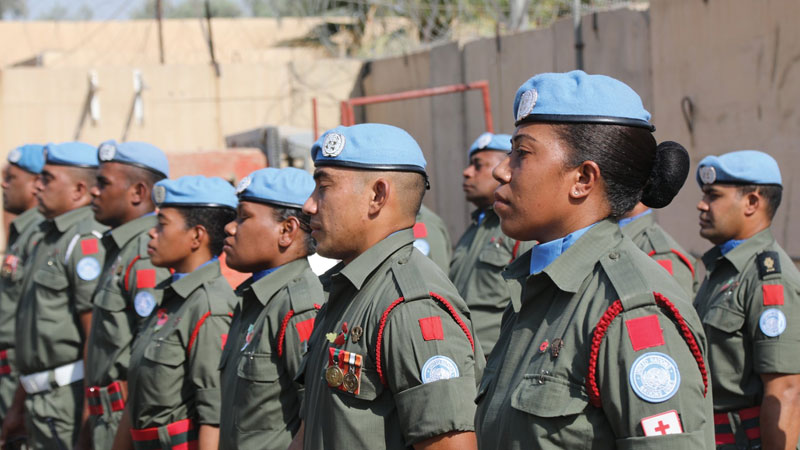
FIJI stands tall in the eyes of the world for its steadfast contribution to United Nations peacekeeping missions. Our soldiers — disciplined, culturally adept, and hardened — have earned global recognition for their professionalism in volatile regions of the world.
But a critical question is emerging that can no longer be ignored:
At what cost to Fiji and its people?
Fiji is a small island developing state with finite resources and urgent domestic challenges. We are fighting on too many fronts — poverty, drug addiction, a public health system of third world standards, and yawning gaps in our maritime spaces that give rise to exploitation and insecurity.
Yet Fiji continues to stretch itself thin by subsidising peace and stability in other parts of the world at the expense of mounting problems at home.
A nation in crisis
Across Fiji, there is rising alarm over the surge in methamphetamine use, particularly among the youth.
Transnational drug networks are exploiting Fiji’s porous borders and under-resourced enforcement systems. The social damage is mounting—broken homes, rising crime, lost futures.
At the same time, HIV infections — especially among young iTaukei — are climbing at an unprecedented and alarming rate.
Public health standards remain weak and underfunded. Hospitals and clinics struggle to meet basic needs, let alone respond to infectious disease outbreaks.
Add to this the rampant illegal and unregulated fishing in Fiji’s Exclusive Economic Zone (EEZ) that extends across 1.3 million square kilometres of the South Pacific Ocean.
Foreign fishing fleets — some operating without licenses — are plundering our marine resources with impunity.
These activities undermine food security and environmental sustainability given that most of the population depend on the sea for their sustenance.
In light of these challenges, many are asking: Would it not be more prudent for Fiji to reduce its peacekeeping footprint and redirect some of those resources toward addressing some of these pressing internal challenges?
The real cost of peacekeeping
Fiji’s continued commitment to far-flung peacekeeping missions raises a difficult but necessary question: Is Fiji doing enough to protect its own homeland?
The recently completed National Security and Defence Review urged the Fiji Government to consider a ‘strategic rebalancing’ i.e. a deliberate shift in priorities that redirects some of its overseas commitments towards urgent domestic needs.
This is not about Fiji abandoning peacekeeping. It is about recalibrating our efforts so that, in the search for respect and honour abroad, we do not neglect our home base.
The 2025-26 budget has allocated $168 million to the Republic of Fiji Military Forces (RFMF).
This includes $52 million for overseas peacekeeping. What if just a fraction of the budget, the equipment, and the manpower currently devoted to UN missions were instead deployed to:
The answer is clear: if Fiji did so it would be safer, stronger, and a more resilient nation.
Sovereignty begins at home
True security begins not in the Golan Heights or the deserts of Sinai, but in the streets of Suva, the islands of Lau, and in the highlands of Naitasiri.
It begins with the safety of our families, the health of our people, and the protection of Fiji’s bio-diversity – these are all part of Fiji’s natural inheritance.
Fiji must now consider where its comparative advantage lies.
Is it in propping up peace on the other side of the world? Or in reclaiming control over its borders, rebuilding public services, and investing in the next generation of Fijians?
A proud past, a responsible future Fiji’s peacekeepers have served with honour. Their sacrifices are not in vain. But the world is changing — and so must we.
This is not a retreat. It requires a ‘rebalancing ‘of priorities. The Fiji government needs to be bold, to act with wisdom, and to ensure that its first duty is to its people.
Fiji can still lead with dignity on the world stage — but it should not forget the home base they are meant to protect.
The views expressed in this article are solely those of the author and do not necessarily reflect the opinions or policies of USP Journalism or this training news website.