Take our short quiz to see which programme might suit you best. There are no right or wrong answers!

Take a double major in Linguistics and another subject of your choice (we recommend Psychology, Literature, Pacific Vernacular Language, Journalism, History or Computer Science as good combinations with Linguistics). In the eight-course Linguistics major, you will learn about languages from across the region, and tackle topics such as endangered languages, language learning, the relationship between language and the environment, and language technology. Students who enjoy logic puzzles and were good at Maths, Computing and Language subjects at school will particularly enjoy Linguistics! See our careers page for jobs that rely on Linguistics.
A major in Linguistics (taken as part of a double major) comprises eight courses. All students take the following four courses:
Students then choose four of the following courses:

If you enjoyed English at school and are not sure whether you prefer the literature part or the language part, you can continue studying both! A major in Literature/Language gives you the opportunity to study four Literature courses and four Linguistics courses (or more if you choose a single major). This combination gives you strong analytical and critical thinking skills, which are valued by employers in all sectors. However, to get the most out of this subject combination, we strongly recommend taking a double major with one major in Linguistics (see above) and one major in Literature.
You can study:
However, to get the most out of this subject combination, we strongly recommend taking a double major with one major in Linguistics and the other major in Literature.
Double major in Literature/Language
All students on this programme take the following three Linguistics courses:
The fourth Linguistics course for double major students is chosen from the following:
Single major in Literature/Language
Students completing a Single Major in Literature/Language will take twelve courses in total, six from Literature and six from Linguistics.
The six Linguistics courses on this major are: LN111, LN118, LN211, LN216, plus two from LN311, LN315, LN316, LN317, LN318 and LN319.

This degree programme offers an entry route to a fast-moving interdisciplinary area in which we cannot predict your future! All we know is that the future will involve both language and technology!
During this programme, you will learn about the languages of the Pacific (including those which are becoming replaced by English or more dominant dialects); you will gain the skills needed to work across both Linguistics and Technology; you will understand how languages are learnt and also documented or described; and your programme will culminate with the capstone course IS314: Computing Project, through which you will help to develop a solution to a real-world problem relating to one or more Pacific languages.
The programme combines courses in Linguistics, Computer Science and Information Systems, and you are also required to take at least one language course (either learning a new language for the first time to gain that experience, or studying your own language in more depth – different options are available to you, depending on your location and your previous language experience).
For programme requirements and further information click here.

If you are seeking a professional career in media, marketing or communication roles in a variety of sectors, industries or organisations this prescribed programme of 24 courses (Communication cannot be taken as a major) may be perfect for you. The programme combines Linguistics, Journalism, Marketing and a specialist subject in any area of your choice. The specialist subject enables you to become an expert in a field in which you wish to target communication roles (e.g. Environment or Social Work) or to pick up a range of workplace skills (e.g. Accounting, Management, or an additional language).
For programme requirements and information about the specialist subject click here.
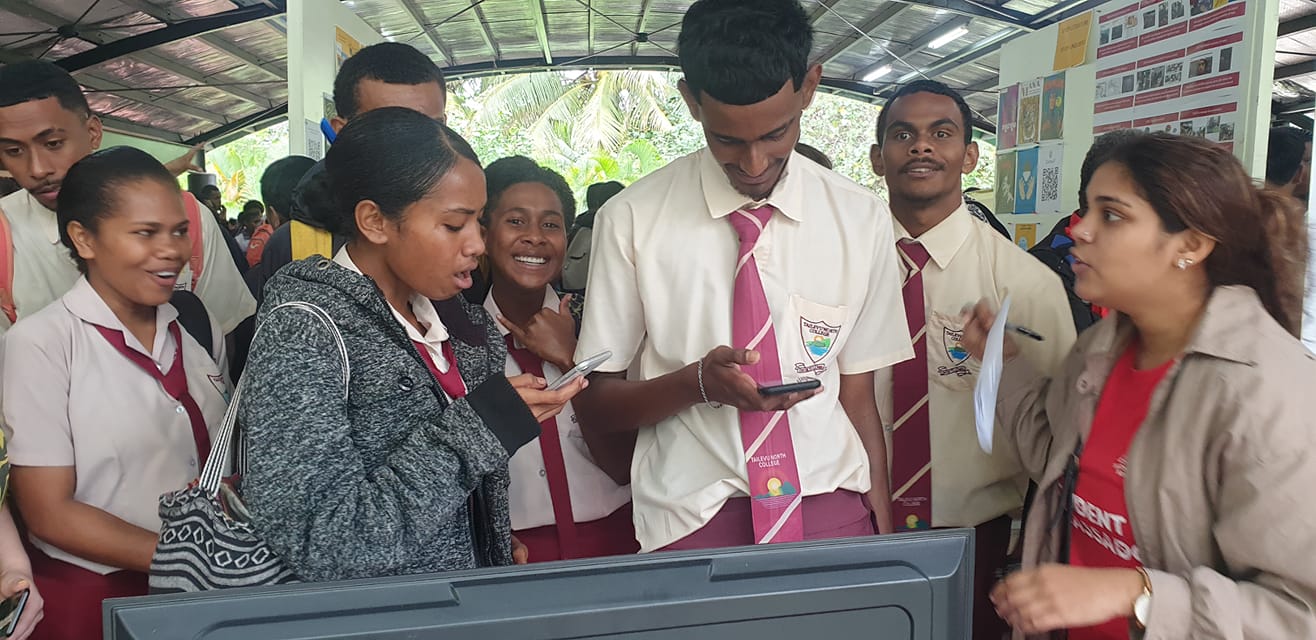
If you enrol on a pre-service or in-service programme to become a secondary teacher of English, you will take five Linguistics courses as part of the Literature/Language component of your programme. These courses cover an introduction to how languages work in general, an overview of languages across the Pacific as well as the structure of English, principles of second language learning and teaching, and the role and status of English in the Pacific. These courses will give you a robust training for a career in English teaching, as well as working in curriculum and assessment units.
Core Linguistics courses for the Literature/Language teaching subject: